



Conservation & ProjectsNews & Advocacy
The SLOTHS Act Is Here.
Now We Need to Pass It.
On October 20, 2026, bipartisan federal legislation was introduced in the U.S. House of Representatives that would permanently end the commercial importation of wild-caught sloths into the United States.
The bill exists because of years of scientific work, public pressure, and direct collaboration between the Sloth Protection Alliance and U.S. lawmakers.
The next step is yours.
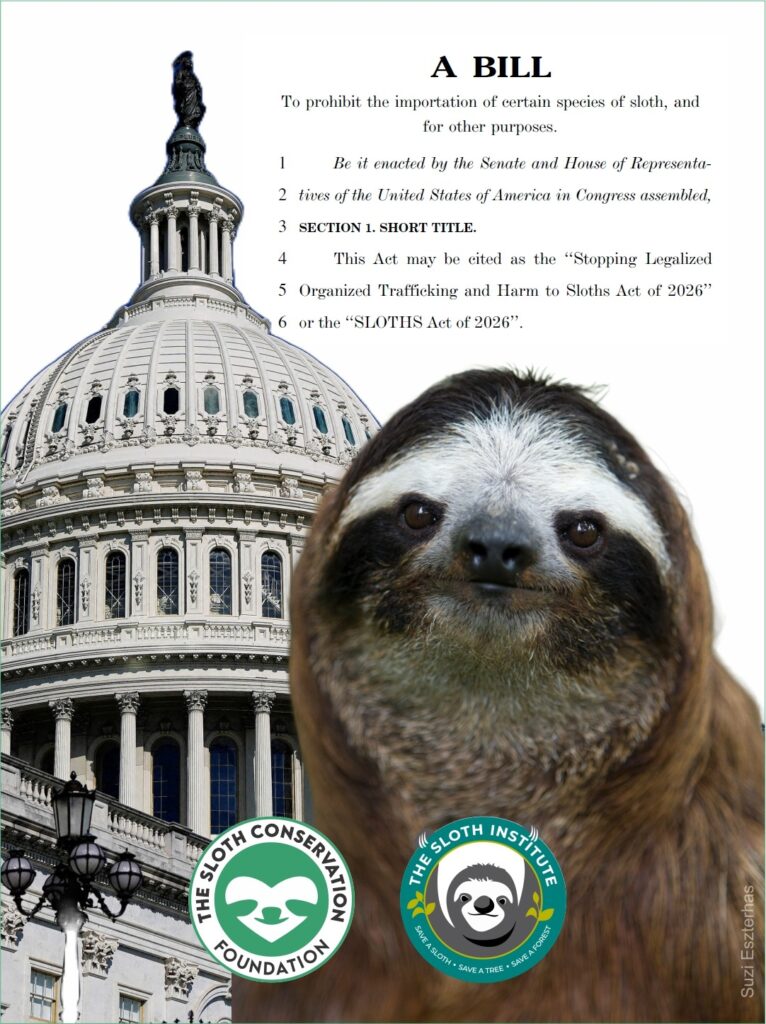
The Stopping Legalized Organized Trafficking and Harm to Sloths Act of 2026, or the SLOTHS Act, is a bipartisan bill introduced by U.S. Representatives Maxwell Alejandro Frost (D-FL) and Laurel M. Lee (R-FL) on International Sloth Day, October 20, 2026.
The bill would permanently prohibit the importation of sloths into the United States for commercial purposes, with narrow exceptions for scientific research and AZA-accredited breeding programs.
It was developed through months of close collaboration between the Sloth Protection Alliance and U.S. lawmakers, and is endorsed by the Association of Zoos and Aquariums, the Animal Welfare Institute, the Animal Legal Defense Fund, and the International Fund for Animal Welfare.
HOW TO SUPPORT THE SLOTHS ACT
Four steps. Any one of them makes a difference.
MAKE YOUR VOICE HEARD
Contact Your U.S. Representative
This is the single most effective thing you can do. Congressional offices give the greatest weight to messages from their own constituents. Find your representative and ask them to co-sponsor the SLOTHS Act and urge the House Committee on Natural Resources to advance it.
Find Your House Representative
Find Your Senator
Not sure what to say? Use one of the templates below.
Phone Script
Hello, my name is [Name] and I live in [City, ZIP Code]. I am calling to ask Representative [Last Name] to co-sponsor the bipartisan SLOTHS Act, which would permanently prohibit the commercial importation of wild-caught sloths into the United States.
Between 2011 and 2021, more than 1,100 wild-caught sloths were legally imported into the United States. This bill would close the import pipeline driving their capture and suffering.
Will the Representative co-sponsor the bill and encourage the House Committee on Natural Resources to advance it?
Thank you.
Email or Letter Template
Subject: Please Support the SLOTHS Act
Dear Representative [Last Name]
As your constituent, I am writing to urge you to co-sponsor the Stopping Legalized Organized Trafficking and Harm to Sloths Act of 2026, the SLOTHS Act, introduced by Representatives Maxwell Frost and Laurel Lee.
Between 2011 and 2021, more than 1,100 wild-caught sloths were legally imported into the United States. More than 90% of sloths captured for this trade do not survive the journey. The SLOTHS Act would permanently prohibit sloth imports, with limited exceptions, and address the problem at its source by reducing the demand that drives wild sloth capture.
[Add a sentence explaining why this matters to you personally.]Please co-sponsor the bill and encourage the House Committee on Natural Resources to bring it forward for markup.
Sincerely,
[Full Name][Street Address][City, State, ZIP Code]
WHY THIS BILL MATTERS
Every sloth imported for commercial use in the United States begins its journey the same way: captured from a rainforest, separated from its habitat, and subjected to a level of stress that most do not survive.
Between 2011 and 2021, 1,141 of 1,146 live sloths imported into the United States were wild-caught. The trade more than doubled over that decade. More than 98% of documented shipments entered through Miami, Florida.
An estimated 90% of wild-caught sloths die during capture and transport. When the loss of mothers is included, each sloth reaching the commercial market may represent the disappearance of up to 20 animals from wild populations.
This is also a One Health concern. The Changuinola virus, not currently reported in the United States, was detected in sloths connected to Sloth World Orlando. Importing unscreened wild animals creates a documented biosecurity risk to domestic wildlife, ecosystems, and public health.
No facility regulation can undo what happens at the moment of capture. The SLOTHS Act addresses the problem at its source.