
The SLOTHS Act Is Here: Bipartisan Bill to Permanently End the Importation of Wild Sloths into the United States
Published by The Sloth Institute | In alliance with The Sloth Conservation Foundation | October 20, 2026, for International Sloth Day
Today is International Sloth Day. And today, something we have been working toward all year is starting to become real.
U.S. Representatives Maxwell Alejandro Frost (D-FL) and Laurel M. Lee (R-FL) introduced the Stopping Legalized Organized Trafficking and Harm to Sloths Act of 2026, known as the SLOTHS Act, a bipartisan bill that would permanently prohibit importing sloths into the United States.
We helped build this. And today, we want to tell you exactly what it means.
What Is the SLOTHS Act?
The SLOTHS Act is federal legislation with one clear goal: to end the pipeline that brings wild-caught sloths from South American rainforests into commercial exhibitions, roadside zoos, and the pet trade in the United States.
The bill would prohibit the importation of sloths into the United States, with two narrow exceptions. Deceased sloths may still be imported for documented scientific research purposes. Eligible captive sloths may be transferred to institutions accredited by the Association of Zoos and Aquariums as part of established breeding programs. Critically, sloths taken from the wild after the bill’s enactment would not qualify for the captive-transfer exception, closing a loophole that has allowed the trade to operate.
Violations under the SLOTHS Act could result in civil penalties of up to $20,000, criminal fines of up to $100,000 for knowing violations, cancellation of applicable federal authorizations, and forfeiture of any illegally imported sloths.
The SLOTHS Act is the direct result of what happened at Sloth World Orlando and of the work that followed.
In early 2026, we joined forces with The Sloth Conservation Foundation to expose Sloth World, a commercial facility that had legally imported more than 60 wild-caught sloths from Guyana and Peru for a planned public exhibition. 58 of those sloths died. The survivors were transferred to the Central Florida Zoo in critical condition. The Orange County Sheriff’s Office investigated and referred the case to the State Attorney’s Office, which continues to review it.
What Sloth World made visible is a trade that has been operating quietly for years. Between 2011 and 2021, 1,146 live sloths were imported into the United States. Of those, 1,141 were wild-caught. Approximately 97% came from Guyana. Live sloth imports more than doubled over that decade. And more than 98% of all documented shipments entered the United States through Miami, Florida.
These are not numbers without consequence. Traffickers target infant sloths, sometimes killing mothers to reach their young. Estimates suggest that for every sloth that reaches a commercial facility, at least nine die during capture and transit. When the loss of mothers is included, each sloth sold may represent the disappearance of up to 20 animals from wild populations.
The people paying to hold sloths at encounter experiences almost never know this. The SLOTHS Act is designed to close the supply chain that makes those encounters possible in the first place.
Our co-founder and Executive Director Sam Trull has been working toward this moment for more than a decade:
Sam Trull, MSC
Co-founder and Executive Director, The Sloth Institute"When I first learned about the commercial trade in wild sloths more than a decade ago, I could only dream of one day helping introduce a bill like this: legislation with a single goal that is both simple and comprehensive, to end the removal of sloths from the wild for commercial import into the United States. Sloths are wild animals that deserve to live in peace where they belong, and the American people deserve to stop being misled about where these animals come from."
Dr. Rebecca Cliffe, founder and Executive Director of The Sloth Conservation Foundation, made a promise when the first animals died at Sloth World. Today she honored it:
Dr. Rebecca Cliffe
Founder and Executive Director, The Sloth Conservation Foundation"After the deaths of 58 sloths at Sloth World, we made a promise to do everything in our power to make sure something like this could never happen again. The SLOTHS Act is an opportunity to finally draw a line and say that this is not acceptable. We cannot undo the suffering of the sloths already caught up in the trade, but we can make sure their suffering was not in vain."
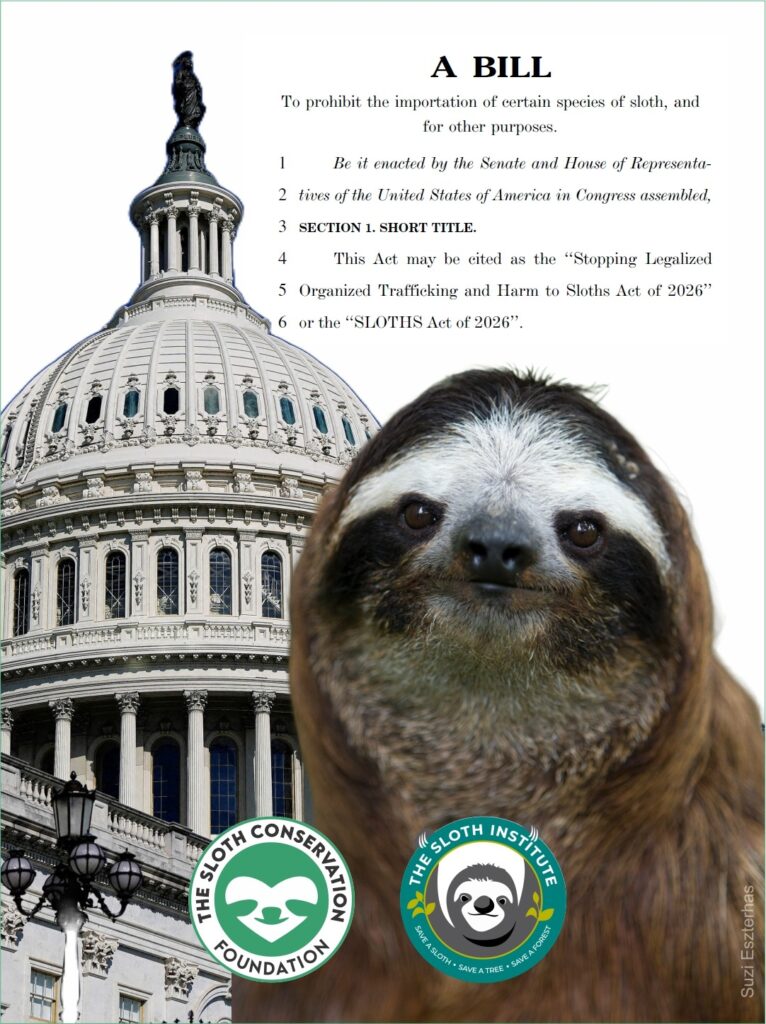
The SLOTHS Act was introduced by both a Democrat and a Republican. That is not a small thing.
Representative Maxwell Frost, who represents the Orlando district where Sloth World operated, has been directly engaged with this issue since the story broke. Representative Laurel Lee’s co-sponsorship reflects growing recognition across party lines that existing wildlife laws have failed to adequately protect sloths entering the United States.
THE BILL IS ENDORSED BY:
- Association of Zoos and Aquariums,
- The Animal Welfare Institute,
- The Animal Legal Defense Fund, and
- The International Fund for Animal Welfare
That breadth of support signals this is not a fringe issue. It is a mainstream wildlife protection priority with genuine legislative momentum.
We want to be clear about the scope of this bill, because clarity matters for the next steps.
The SLOTHS Act focuses specifically on importation. It does not prohibit owning or exhibiting sloths already in the United States. There are sloths in commercial facilities across the country right now, and their welfare remains a serious concern that requires separate action.
Through the Sloth Protection Alliance, we will continue advocating for stronger welfare standards for sloths already in captivity, an end to hands-on sloth encounters, greater transparency around animal deaths in commercial facilities, and broader accountability across the captive wildlife industry.
This bill is not the end of the work. It is one of the most important steps in it.
Following its introduction, the SLOTHS Act is expected to be referred to the House Committee on Natural Resources, which oversees wildlife policy, international wildlife matters, the U.S. Fish and Wildlife Service, and the Lacey Act.
The Sloth Protection Alliance is urging committee leaders and members to consider the bill promptly, schedule a hearing, and bring it forward for markup so it can advance to the full House of Representatives.
This is where your voice matters. Lawmakers respond to constituent pressure. The more people who contact their representatives, sign the petition, and share this news, the stronger the signal that the American public wants this to move forward.
What is the SLOTHS Act?
The Stopping Legalized Organized Trafficking and Harm to Sloths Act of 2026 is federal legislation introduced on October 20, 2026, that would permanently prohibit the importation of sloths into the United States for commercial purposes.
Who introduced the SLOTHS Act?
The bill was introduced by U.S. Representatives Maxwell Alejandro Frost (D-FL) and Laurel M. Lee (R-FL) on International Sloth Day, October 20, 2026
What does the SLOTHS Act prohibit?
It prohibits the importation of sloths into the United States, with narrow exceptions for deceased sloths imported for documented scientific research and eligible captive sloths transferred to AZA-accredited institutions for breeding programs.
What are the penalties under the SLOTHS Act?
Civil penalties of up to $20,000, criminal fines of up to $100,000 for knowing violations, cancellation of federal authorizations, and forfeiture of illegally imported sloths.
Does the SLOTHS Act ban owning sloths in the United States?
No. The bill focuses specifically on importation and does not prohibit the ownership or exhibition of sloths already inside the United States.
Why does the United States need this law?
Between 2011 and 2021, 1,141 of the 1,146 live sloths imported into the United States were wild-caught. The trade doubled in that decade. Existing wildlife laws have not been sufficient to stop it.
Who supports the SLOTHS Act?
The bill is endorsed by The Sloth Institute, The Sloth Conservation Foundation, the Association of Zoos and Aquariums, the Animal Welfare Institute, the Animal Legal Defense Fund, and the International Fund for Animal Welfare.
What is the Sloth Protection Alliance?
The Sloth Protection Alliance is a collaboration between The Sloth Conservation Foundation and The Sloth Institute, working to end the commercial importation of wild-caught sloths into the United States and strengthen protections for sloths already in captivity.
How can I help pass the SLOTHS Act?
Contact your U.S. Representative and ask them to co-sponsor the bill, sign the petition, support the campaign financially, and share this post with your network.
What happens after the SLOTHS Act is introduced?
The bill is expected to be referred to the House Committee on Natural Resources. The Sloth Protection Alliance is urging the committee to schedule a hearing and bring the bill forward for markup so it can advance to the full House.
Real policy change requires science, public awareness, legal expertise, and sustained advocacy. The SLOTHS Act has been introduced. Now it needs to move.
Share our work: Tag your representatives. Share this post. Tell people what International Sloth Day means this year. 58 sloths died. Today their suffering means something. And we are not done until the trade that killed them is over.
FUND THE FIGHT
CONTACT YOUR REPRESENTATIVE
Find your U.S. Representative at house.gov/representatives/find-your-representative and tell them you support the SLOTHS Act and want them to co-sponsor it.
Not sure what to say? Copy this:
“I am writing to urge you to co-sponsor the SLOTHS Act of 2026. Between 2011 and 2021, more than 1,100 wild-caught sloths were legally imported into the United States. Fifty-eight died at a single facility in Florida.
This bill would close the import pipeline that makes that possible.
Please support it.”